
You already know you want to pay off your debt. The harder question is how to create a debt payoff plan that actually holds up. One that survives the car breaking down or a birthday invite landing the same week rent is due. Most plans fail quietly. Not because you lacked motivation, but because there was never a real system underneath the good intentions. This guide walks through the exact steps. Seeing your full numbers, choosing a method that fits how you think, building it into your budget, and adjusting it without starting over.
Why Most Debt Payoff Plans Fall Apart
“Pay more when I can” is not a plan. It is a hope. Most debt payoff attempts collapse because there is no target date and no specific dollar amount. There is no honest look at where the money is actually going each month. You throw $50 at a card in a good week and nothing in a tight one. A year later the balance has barely moved and it feels like proof that debt payoff does not work for you. It was not you. It was the absence of a plan.
There is also the shame spiral. You miss a month, feel like a failure, and quietly stop looking at the numbers altogether. Silence does not make a balance smaller. It just means the next time you check, the surprise is worse. If burnout has already crept in, our guide on how to pay off debt fast without losing your mind is worth reading alongside this one.
Step 1: Get the Full, Honest Picture of What You Owe
Before you can build anything, you need every debt in one place. Balance, interest rate, and minimum payment, no exceptions, even the $200 you owe your sister.
| Debt | Balance | Interest Rate | Minimum Payment |
|---|---|---|---|
| Credit Card A | $3,200 | 24.99% | $85 |
| Credit Card B | $1,450 | 19.99% | $45 |
| Car Loan | $8,900 | 6.5% | $210 |
| Personal Loan | $650 | 11% | $60 |
| Total | $14,200 | $400 |
Seeing the full total in one place is usually the most uncomfortable part of learning how to create a debt payoff plan. It is also the part that makes everything after it easier, because you are no longer guessing.
Do not forget the debts that do not feel like debts. Buy now, pay later installments, a medical bill on a payment plan, or the store card you opened for one discount all count. If it has a balance and a due date, it belongs on this list. Missing one now means rebuilding the whole plan later when it surfaces.
Step 2: Pick Your Payoff Method
There are two well-known approaches, and they are not interchangeable.
| Method | How It Works | Best For | Trade-off |
|---|---|---|---|
| Snowball | Pay the smallest balance first, minimums on everything else | Momentum and motivation | You may pay more interest overall |
| Avalanche | Pay the highest interest rate first, minimums on everything else | Saving the most money | Slower visible wins early on |
The avalanche method is mathematically better. The snowball method wins more often in real life, because closing out a whole account fast gives you proof the plan works. For most women rebuilding motivation alongside their finances, the snowball’s early wins matter more than a few extra dollars in interest. Pick avalanche if the math genuinely motivates you more. Otherwise, take the win.
Step 3: Build the Extra Payment Into Your Budget
A payoff method means nothing without a real number behind it. Go through your spending plan and find what you can actually put toward debt beyond the minimums, whether that is $40 or $400. If your budget currently exists mostly in your head, this step-by-step budgeting guide will help you build one first. And if you are not sure which budgeting method fits how your brain works, this breakdown of popular budgeting methods is a good next stop.
Once you know the number, write it into the budget as its own line, same as rent. Not “whatever is left.” A specific amount, moved on a specific day.
Step 4: Automate It and Protect It From Bad Months
Set minimums on every debt to autopay so a missed due date never derails you. Then automate the extra payment too, ideally the day after payday, before it can quietly disappear into takeout and impulse buys.
Keep a small buffer of $300 to $500 sitting untouched in a separate account. One car repair should not knock your whole plan off course. Without that cushion, a single bad month turns into three months of “I’ll restart the plan next paycheck,” and next paycheck rarely comes.
Step 5: Track Progress and Adjust When Life Changes
Check the numbers once a month, not every day. Daily checking just breeds anxiety over normal fluctuation. A monthly check tells you whether the plan is working and whether life has changed enough to need an update.
Got a raise? Increase the extra payment. Lost hours at work? Drop the extra payment temporarily rather than abandoning the plan entirely. A debt payoff plan that cannot flex is a plan that eventually gets thrown out completely.
A basic spreadsheet works fine for tracking this. So does a free app if you would rather see a visual progress bar. What matters is that you actually open it once a month, not which tool holds the numbers. The plan only works if you keep looking at it.
A Real Example: Paying Off $14,200 in 22 Months
Using the sample debts above, here is what the snowball method looks like with $250 extra a month on top of the $400 in minimums.
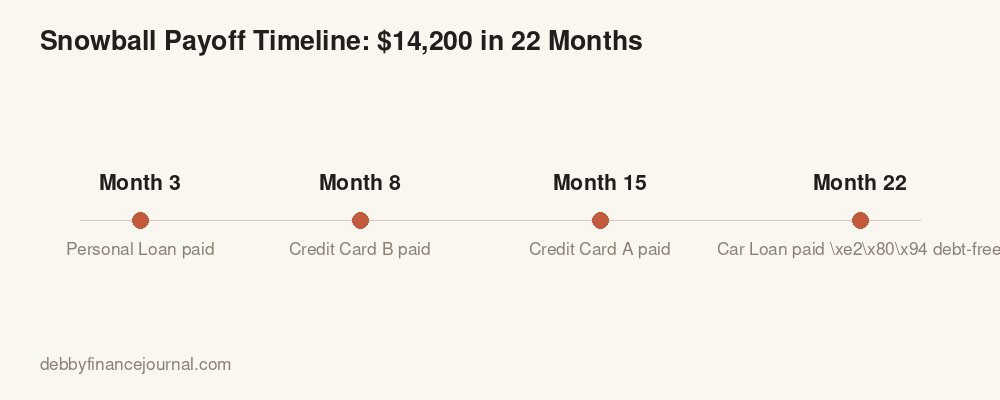
Personal Loan gets $250 extra and closes in three months. That $310 (minimum plus extra) then rolls onto Credit Card B, closing it by month eight. From there, $355 rolls onto Credit Card A, clearing it by month fifteen. Finally, the full $650 rolls onto the car loan, paying it off by month twenty-two, months ahead of its original schedule.
Nothing about this requires a windfall or a side hustle. It requires the plan, the extra $250, and sticking with it when a slow month tempts you to skip.
Mistakes That Quietly Wreck a Debt Payoff Plan
The most common one is switching methods every few weeks because progress feels slow. Pick one and give it at least three months before judging it. Another is forgetting to update the budget after a debt closes, so the freed-up payment just gets absorbed into everyday spending instead of rolling forward. A third is treating the plan as punishment rather than a decision you are making for your own future.
Where Debt Consolidation and Balance Transfers Fit In
Consolidation is not the same as a payoff plan, and it will not replace one. The National Credit Union Administration has good guidance on vetting any debt help service before you sign up for one. A balance transfer card or a consolidation loan can lower your interest rate. That means more of each payment chips away at the balance instead of feeding interest. That is genuinely useful. It is also not a shortcut.
If you consolidate without changing the spending habits that built the debt, the old cards tend to creep back up. Now you are paying off two things instead of one. Use consolidation as a tool inside your plan, after you have already built the budget line from Step 3, not as a replacement for one.
Common Questions About Building a Debt Payoff Plan
Should I pause saving while paying off debt? Keep contributing enough to get any employer retirement match. Beyond that, most high-interest debt above 15 percent or so is worth prioritizing over extra saving, since few savings accounts outpace that interest rate.
What if I have both federal and private student loans? Treat them as separate line items in your debt list from Step 1. Federal loans often have more flexible repayment options, so factor that into whether snowball or avalanche fits your full picture better.
How much should the “extra” payment actually be? Whatever you can sustain for months, not just one good paycheck. A realistic $75 a month beats an ambitious $300 you abandon after five weeks.
The Bottom Line on How to Create a Debt Payoff Plan
A debt payoff plan is not complicated. It is specific. Real numbers, a method you will actually stick with, a protected budget line, and a monthly check-in to adjust when life does what life does. That is how to create a debt payoff plan that survives contact with an actual month, not just a spreadsheet.


